Home Education IGCSE Courses
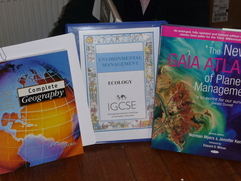
- Student file with tutor marked assignments
- Complete mock exam
- Recommended Textbook(s)
- Study Planner
- Exam Syllabus
- Exam Information
Although it is not compulsory for children following programmes of home education to study for formal qualifications, many students feel it is in their interests to work towards nationally and internationally recognised certificates. Such qualifications are usually asked for by colleges and employers and are an indication that applicants have reached a certain level of academic achievement. English Language, Maths and Science are the subjects normally required as basic, a grade C being considered adequate for most purposes unless a student wishes to specialise in that subject. Beyond these core skills, there is a range of subjects suitable for home study, depending on the interests and eventual career aims of the student.
At school, students normally commence GCSE studies at 14 and spend two years studying between 5 and 10 subjects. Examination Boards also view their courses as suitable for studying over a two year period. However, this is a matter of choice and depends entirely on aptitude and how much time you wish to commit to study. On average, a course will consist of 150 - 200 hours of study. You therefore need to consider how much time you realistically can spend studying. At school, a student will be in school for around 30 hours a week, 36-40 weeks of the year. In addition, there may be 10-12 hours a week spent on homework. Working at home, it may be more practical to consider attempting three GCSEs a year. This would involve you in some 12 hours of study a week. If you take on more subjects, you need to allow more time!
All our IGCSE courses contain a student file including tutor-marked assignments, study planner, recommended textbook(s) and a copy of the exam syllabus. No other books are needed. If, during a unit of study, you encounter any problems, these can always be noted down and included with your assignment. Your tutor will then try to assist you with the query. Don’t worry if you cannot answer an assignment question - the questions are intended to pick up on any misunderstandings and your tutor will offer constructive comments and provide detailed feedback where necessary. The final assignment, a complete CIE mock exam, will allow you to assess your progress and decide at which level to enter the exam. Some subjects offer either Core (for grades up to and including C) and Higher (Extended) for grades up to A*. On completion of your course, further exam papers can be purchased from the school for additional practise if required.
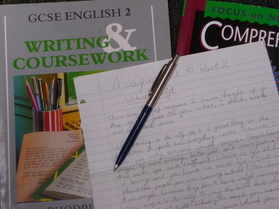
This is an English language course that will very much appeal to many home-educators being almost wholly concerned with the use of language.
There are no 'set books' and no literary criticism elements. The aim is 'to enable students to communicate, understand and respond accurately, appropriately and effectively; to encourage students to appreciate a variety of language;
to promote students' personal development and understanding of themselves and to complement other areas of their study by developing skills of analysis, drawing inferences etc.'
A worthwhile course to provide a basic qualification required by many employers and institutions of further education. Study guide - approximately 100-150 hrs
This course assumes students are already achieving level 6-7 at National Curriculum or have completed our English 13-14 course.
(Note that, if you are uncertain about what level your child is currently working at, there are SATS papers with mark schemes and
assessments of levels available free online or from good bookshops or Amazon.)
The course has 12 assignments. Examination by two papers - all students now take the same paper
For many colleges, universities, training schemes and employment opportunities, GCSE Maths is considered an essential entry requirement. Yet, for many, Maths is a very demanding subject. This is therefore one of the courses we offer at two different levels.
Core Maths deals with the basics. It will allow you to achieve up to and including a grade C (new level 4) but, because the number of topics you cover is more limited, it allows you to concentrate more fully on these subjects. Our Higher course is much more demanding. This is for maths enthusiasts and those who like to rise to the challenge. Its scope is much greater and requires, we believe, twice as much study time. It will , however, allow you to achieve a grade A* (new level 9). We recommend that only students who are achieving a level 7 at Key Stage 3 should contemplate this course. If you are uncertain of your level, many bookshops offer SATs papers which allow you to test yourself.
For both Core and Higher courses, the final exams consist of two papers. Core students sit papers 1 and 3. Extended candidates take papers 2 and 4.
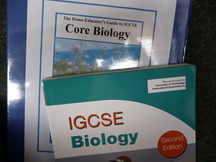
Cambridge International Examinations Board is the only Board to make science subjects really accessible to all. Standard GCSE syllabuses all involve coursework or practical, in-laboratory, tests which are not available to home educators. However, with CIE, students are able to take an 'Alternative to Practical' paper. This presents laboratory-type questions in which students are required to demonstrate an awareness of laboratory procedure, an ability to suggest how experiments might be carried out and and awareness of how to interpret data.
Topics covered by the syllabus include food chains and webs, nutrient cycles, population growth, ecosystems, inheritance, reproduction in plants and humans, nutrition, respiration, nervous control, transport, characteristics of living organisms, classification etc. Full details can be seen by visiting the CIE website and viewing the syllabus specification for IGCSE Biology. Our course and the assignments are aimed at Core level. This is because we believe it is difficult for students to achieve the higher levels without access to a laboratory and the opportunity to carry out practical experiments.
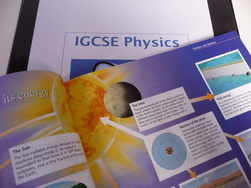
In selecting courses suitable for home educators, we are always mindful of the facilities available and likely access to specialised materials and knowledge. For this reason, our packs and assignments concentrate on core level which we consider more appropriate for learning without access to a laboratory. Core level covers grades up to and including C.
This is a standard GCSE Physics course in content, covering Forces and Motion, Work and energy, Density and pressures, Molecular motion and heat, Light and sound waves, Electrical energy, magnets and currents, Electrons and atoms. For home educators there is a special 'Alternative to Practical' paper allowing the whole syllabus to be assessed by examination (see Biology.) For Core level, there are three papers in the final exam.
After the second world war, the course then turns to the Cold War, its origins, the conflicting ideologies and some of the major conflicts in Vietnam and Korea. We look at the Cuban Missile crisis and how and why the Berlin Wall was built in 1961 and then dismantled in 1989. We look at the Soviet loss of control over Eastern Europe and seek to understand the reasons behind this.
Finally, the course seeks to understand the background to events in the Middle East in order that more recent politics and conflicts can be put into context.
Alongside this, students learn how to use historical source material and how to draw deductions from the writings, artefacts, cartoons and pictures that are available to historians.
This course is examined via three papers taken by all students. Approximate study time 150-200 hours.
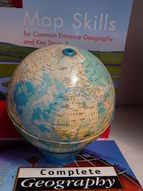
This is a standard Geography course studying how our landscape has evolved, how we use it and possible trends for the future. The syllabus covers both physical and human geography and examines many environmental issues such as global warming, acid rain, population dynamics and alternative energy sources.
This course is closely allied to IGCSE Environmental Management and some topics are covered by both courses, thereby reducing study time if your are enrolled for both subjects. Because the subjects are so complimentary, we strongly recommend students take both courses
This course assumes no previous study of geography but basic numeracy and literacy skills are required. The course involves some 150 hours of study, exams being available in both summer and autumn sittings.
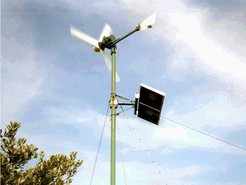
This is one of our most popular courses, ideal for home learners interested in the environment. It investigates how natural systems work - in the air, in water, on land and in living organisms. It then looks at how man has used and abused these systems and, finally, considers ways in which we can protect our world in the future. The course covers many diverse topics including Greenhouse Effect, Acid Rain, the Rain Forests, over-fishing, over-population, the Green Revolution etc. and calls upon students to look positively for solutions both globally and locally.
By the late 1980s, there was growing concern at the speed and apparent irreversibility with which the Earth's resources were being exploited and destroyed. A World Commission on the Environment met, discussed the many problems and produced a report - "Our Common Future" - known as the Brundtland Report. The main concern of the report was to ask how resources could be developed in a sustainable way to meet the needs of all peoples. By "sustainable" it meant using resources in a manner where they could still be available for future generations; by "all peoples" it implied that a restructuring of the world economy would be needed so that the needs of one group of people were not met at the cost of other groups.
The Environmental Management syllabus (or Natural Economy as it was first known) was devised as a response to the Brundtland Report. It sought to inform, particularly young adults in whose hands our planet's future will ultimately lie, how Earth functions - how ecosystems behave, how natural cycles work. It aimed to investigate how man has made use of these natural resources and what the consequences have been. Finally, it sought to discuss future options, to impart understanding of the vast complexity of the problems involved and the repercussions certain policies might have.
The syllabus is still very much based on the principle of: think globally but act locally .It calls upon students to look at local implications, to understand their own local environment and to take a responsible attitude towards its development. It encourages the view that we have not so much inherited the world from our parents as borrowed it from our future children.
Thus, Environmental Management is the ideal choice of subject for anyone concerned for the future of our planet, anyone wanting to study the inter-relatedness of all life on Earth and anyone seeking to take a more altruistic view of life in preference to the self-centred, consumerist attitudes that generally pervade a society that has allowed , and is still allowing, such global and local destruction to take place.
This is a wide ranging course having, as it does, an infinte span of interest. However, as citizens of the future, we hope you will find it fullfilling and worthwhile in advancing your appreciation of the delicate balances on which this planet depends.
There are many readily available videos to support learning and most areas of the country are able to offer a range of venues eg the Eden Project in the West Country, the Centre for Alternative Technology in Wales for those wishing to include field trips.
The course is suitable for students 14+ and, as a rough guide, involves some 150 hours of study. Environmental Management is an ideal subject for anyone seriously interested in sustainable education. This course is being considerably revised for exams from 2019 onwards when the subject will be examined via two papers. Our new course reflects the syllabus changes.
This course includes:
Course textbook
Student file with study planner, specimen questions and answers
11 tutor marked assignments including a complete mock exam
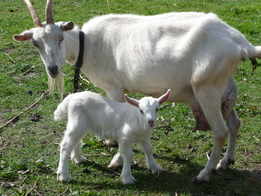
Please note that this is the only course we offer where it is essential to attend our school centre, in the Isles of Scilly, for the purpose of practical demonstrations, assessments and taking the final exam. Please see the separate web page on IGCSE Agriculture for full details.
This course will appeal to anyone interested in farming and growing and takes a wide-ranging look at agriculture - from the soil to crops, livestock, farm buildings and equipment and even farm accounts. It is also a course of benefit to those who are planning to work overseas on voluntary projects where a grounding in agriculture is often invaluable.
The syllabus is international - even some of the textbooks are African! - but students are encouraged to apply general principles to local conditions, especially in selecting an experimental project.
Our pack covers the theoretical aspects of the course. Students are expected to support their studies by gaining practical , hands-on, experience locally on their own farm/smallholding or by assisting at other farms. You should endeavour to log 200 hours of practical experience so that you are proficient in handling livestock and the use of tools. As CIE state: "It is the ethos of IGCSE that practical work is undertaken on a continuous basis."The course gives a very thorough introduction to anyone intending to make a future in Agriculture.
What the course includes:
3 Course files
10 Tutor-marked assignments
A mock exam that is marked and graded by a CIE accredited teacher
The marking and assessment of a 1000 word experimental project. The marks for this project are submitted to CIE and contribute to the final grade achieved.
10 hours of practical assessments carried out at our school centre. These sessions are held in October, prior to the actual exam. The marks from these practical assessments are submitted to CIE and also contribute to the final grade.
Note, the course fee does not include travel and accommodation expenses, nor exam fees.
This is a course of interest to many home educators. It is a "stand alone" course which means that, unlike for example Maths, which builds on knowledge acquired during Key Stage 3 (11-14 years), this course does not assume previous knowledge save for a general level of maths (to allow you to use graphs, charts etc), and English (to enable you to write reports etc.) Many parents find this an attractive option as, being of a less specialised nature than many subjects, parents feel able to assist and encourage their children in understanding the modern business world and its workings.
The course includes a comprehensive textbook covering the IGCSE syllabus and contains lots of case studies and exercises to develop your understanding. These are backed up by ten tutor marked assignments to check you are "on the right track." The final assignment is a complete mock exam which is marked to examination standard and a grade awarded so that you can monitor your progress.
This is a particularly worthwhile course for anyone needing to deal with accounts, be they personal, private accounts, business accounts or club accounts which just about includes everybody!
It aims to enable students to understand the principles and purposes of accounting, to develop a knowledge of accounting concepts, conventions, procedures and terminology; to develop an understanding of the aims and activities of business and non-trading organizations and to develop numeracy, literacy, communication, presentation and interpretation skills.
Above all, the course seeks to encourage attitudes of accuracy, orderliness and logical thought, essential in the presentation of accounts.
A highly useful "life skill" as well as a valuable vocational qualification , this course assumes no prior knowledge.
However, good number skills are important. Suitable for students 14+, the course involves some 150 hours study.